
Back to courses20 lessons 1
Course overview
Modulation
Carrier modulation concepts and signal representation methods used in modern telecom systems.
Start course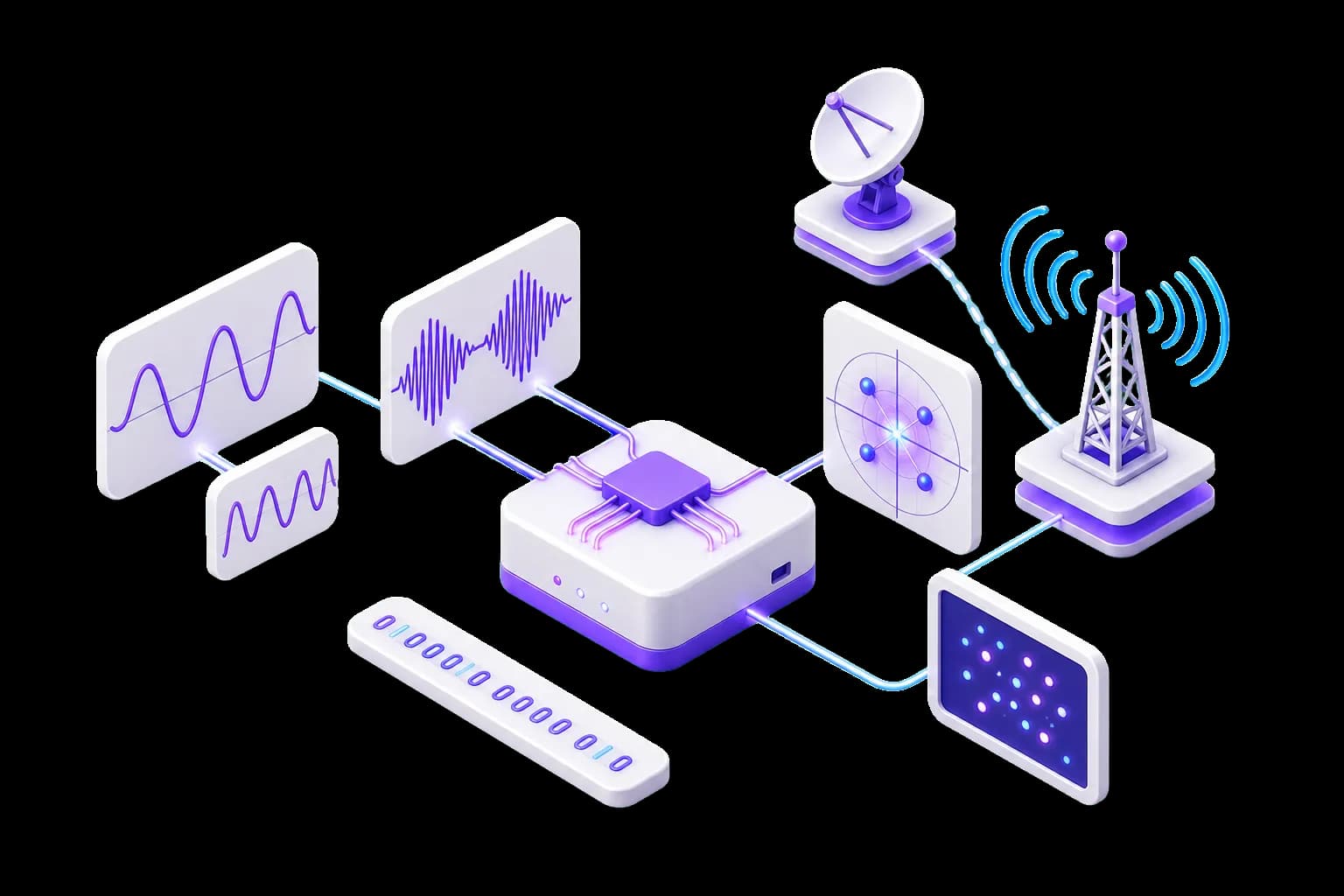
Course lessons
Follow this path using the existing Teleinf Edu article library.
- 01Lesson 1What is Modulation? | Teleinf EduMoving an information signal to a selected passband with a carrier wave.2 min read
- 02Lesson 2Amplitude Modulation (AM) | Teleinf EduAmplitude modulation of a carrier wave, including DSB-WC, DSB-SC, and SSB variants.2 min read
- 03Lesson 3Frequency Modulation (FM) | Teleinf EduVarying the frequency of the carrier. Concepts of deviation and modulation index.2 min read
- 04Lesson 4Phase Modulation (PM) | Teleinf EduVarying the phase of the carrier wave and its relationship with FM.2 min read
- 05Lesson 5Amplitude-Shift Keying (ASK) | Teleinf EduDigital modulation by switching between discrete amplitude levels.2 min read
- 06Lesson 6Frequency-Shift Keying (FSK) | Teleinf EduDigital modulation by switching between discrete frequency levels.2 min read
- 07Lesson 7Phase-Shift Keying (PSK) | Teleinf EduThe general principle of digital modulation by shifting the phase of the carrier.2 min read
- 08Lesson 8Constellation Diagrams | Teleinf EduVisualizing digital modulation schemes in the I-Q plane.2 min read
- 09Lesson 9Binary Phase-Shift Keying (BPSK) | Teleinf EduThe simplest form of PSK, using two phases to encode 1 bit per symbol.2 min read
- 10Lesson 10Quadrature Phase-Shift Keying (QPSK) | Teleinf EduUsing four phases to encode 2 bits per symbol, doubling the data rate of BPSK.2 min read
- 11Lesson 11Offset QPSK (OQPSK) | Teleinf EduA QPSK variant that limits direct phase reversals and reduces envelope variation after pulse shaping.2 min read
- 12Lesson 12Differential PSK (DPSK) | Teleinf EduEncoding information in the phase difference between symbols to simplify receivers.2 min read
- 13Lesson 13Dual-Polarization QPSK (DP-QPSK) | Teleinf EduDoubling spectral efficiency by transmitting two independent QPSK signals on orthogonal polarizations.2 min read
- 14Lesson 14M-ary Phase-Shift Keying (M-PSK) | Teleinf EduGeneralizing PSK to M phases; when M=2^N, each symbol carries log2(M) bits.2 min read
- 15Lesson 15MSK and GMSK | Teleinf EduContinuous-phase FSK schemes, including Minimum Shift Keying.2 min read
- 16Lesson 16Quadrature Amplitude Modulation (QAM) | Teleinf EduCombining ASK and PSK for high spectral efficiency (16-QAM, 64-QAM).2 min read
- 17Lesson 17Pulse Amplitude Modulation (PAM) | Teleinf EduModulating the amplitude of a pulse train, a key step in sampling.2 min read
- 18Lesson 18Pulse Width Modulation (PWM) | Teleinf EduEncoding information in the duration (width) of pulses.2 min read
- 19Lesson 19Pulse Position Modulation (PPM) | Teleinf EduEncoding information in the time position of pulses.2 min read
- 20Lesson 20Pulse Density Modulation (PDM) | Teleinf EduRepresenting an analog signal's amplitude via the density of pulses.2 min read
Course quizzes
Pass the assigned quiz to finish the course progress.