
Back to courses18 lessons 1
Course overview
IP
Internet Protocol addressing, routing identity, and packet delivery structure.
Start course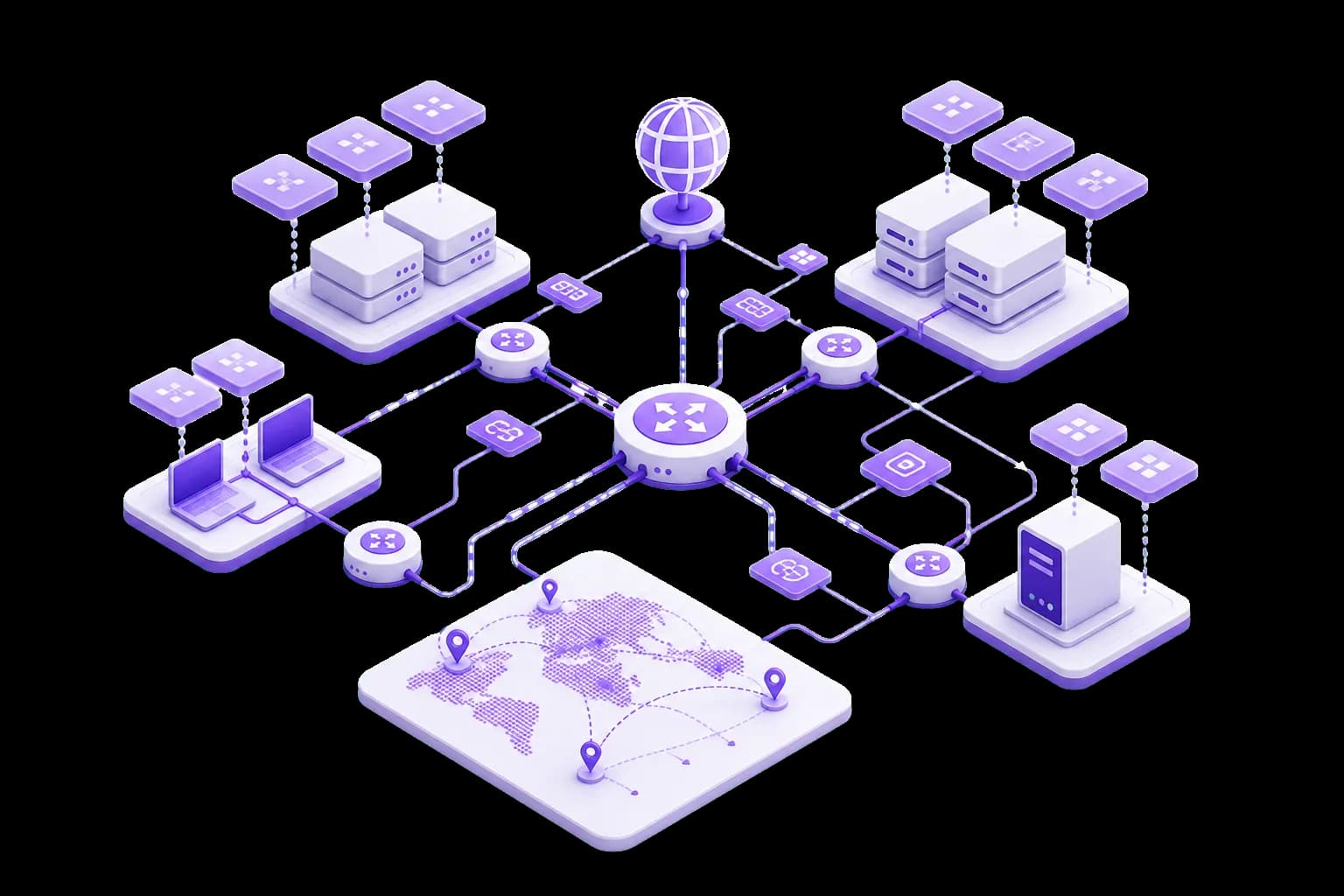
Course lessons
Follow this path using the existing Teleinf Edu article library.
- 01Lesson 1IPv4 Addressing | Teleinf EduClassful addressing, subnetting, Variable Length Subnet Masking (VLSM), and CIDR.2 min read
- 02Lesson 2IPv6 Addressing | Teleinf EduThe 128-bit addressing scheme, notation, special addresses, and address shortening.2 min read
- 03Lesson 3IPv4 Packet Header | Teleinf EduAnalysis of the fields in an IPv4 packet header, including fragmentation and TTL.2 min read
- 04Lesson 4IPv6 Datagram Header | Teleinf EduThe fixed structure of the IPv6 base header.2 min read
- 05Lesson 5Subnetting | Teleinf EduDividing IP networks into smaller subnetworks for efficient address allocation.4 min read
- 06Lesson 6VLSM and CIDR | Teleinf EduVariable Length Subnet Masking and Classless Inter-Domain Routing techniques.4 min read
- 07Lesson 7Private Address Ranges | Teleinf EduRFC 1918 private IP ranges, reserved addresses, and special-use addresses.4 min read
- 08Lesson 8NAT and PAT | Teleinf EduNetwork Address Translation and Port Address Translation for private networks.4 min read
- 09Lesson 9IPv4 to IPv6 Transition | Teleinf EduMigration strategies: dual stack, tunneling, and translation mechanisms.4 min read
- 10Lesson 10IP Fragmentation | Teleinf EduHow large IP packets are divided and reassembled across different MTU sizes.4 min read
- 11Lesson 11Internet Control Message Protocol (ICMP) | Teleinf EduError reporting and diagnostic messages in IP networks (ping, traceroute).4 min read
- 12Lesson 12Address Resolution Protocol (ARP) | Teleinf EduMapping IP addresses to MAC addresses in local networks.4 min read
- 13Lesson 13Dual-Stack Networks | Teleinf EduRunning IPv4 and IPv6 simultaneously on the same network infrastructure.4 min read
- 14Lesson 14IPv6 Tunneling | Teleinf EduTunneling IPv6 traffic over IPv4 networks and vice versa.4 min read
- 15Lesson 15Route Aggregation | Teleinf EduSummarizing multiple routes to reduce routing table size and improve efficiency.4 min read
- 16Lesson 16IP Mobility | Teleinf EduMobile IP protocols enabling devices to maintain connectivity while moving.4 min read
- 17Lesson 17IPv6 Neighbor Discovery | Teleinf EduICMPv6-based protocol replacing ARP for address resolution in IPv6 networks.4 min read
- 18Lesson 18IPv6 Stateless Autoconfiguration | Teleinf EduAutomatic IPv6 address configuration without DHCPv6 address assignment.4 min read
Course quizzes
Pass the assigned quiz to finish the course progress.